

The short answer: Does a probiotic help with a yeast infection? Not on its own, but it can help stop the next one: alongside an antifungal, trials show better short-term cure and fewer relapses. For infections that keep returning, we recommend a daily capsule pairing lactobacilli with lactoferrin: Velara Synbiotic Complex.
See how Velara rebuilds your flora →
Key takeaways
- An active yeast infection needs an antifungal. Probiotics alone lose to antifungals over the long run.
- Added to an antifungal, probiotics improved short-term cure and cut six-month recurrence, on low-certainty evidence.
- Probiotics taken around a short antibiotic course did not prevent yeast in the one direct trial.
- In one small trial, oral lactobacilli plus lactoferrin cut six-month recurrence to 29.2 percent, against 100 percent on placebo.
- Velara is built on that same pairing, as a daily habit for women stuck in the loop.
The loop nobody warned you about
You know the routine. The itch starts, you buy the antifungal, it clears, and a few weeks later you are back in the same pharmacy aisle pretending to read the same box.
Women describe it in painfully plain terms. "The antibiotics just make yeast infections happen," one wrote. Another "bounced between BV and yeast infections for a solid year."
You have plenty of company. Recurrent yeast infection, defined as four or more episodes a year, affects about 138 million women worldwide every year, and it peaks between ages 25 and 34 [1]. So the question is fair: can a probiotic finally end this, or is it one more bottle for the bathroom shelf?

Can probiotics help with a yeast infection? What the trials show
The best current answer comes from a 2026 meta-analysis of 14 randomized trials in the American Journal of Obstetrics and Gynecology [2]. It split the question three ways, and the three answers are very different.
- Probiotic plus antifungal, against antifungal alone: clinical cure in the first month was 41 percent more likely, and recurrence at six months fell to a fifth of the risk (relative risk 0.20). No lasting benefit showed up beyond that.
- Probiotic alone, against antifungal: no short-term difference, but antifungals won on long-term mycological cure, meaning no yeast on testing.
- Probiotic alone, against placebo, in recurrent cases: better mycological cure at six months.
The authors rate this evidence low to very low certainty, and we are not going to dress it up. An earlier Cochrane review of 10 trials and 1,656 women landed in the same place: better short-term cure and fewer relapses at one month as an add-on, with no proven long-term cure [3].
The practical reading is simple. The antifungal handles the fire. The probiotic works on what happens after the fire is out.
Do probiotics kill Candida?
In a lab dish, yes. Fluid from Lactobacillus crispatus cut the growth of Candida albicans by more than 60 percent and blocked 88 percent of its shift into the invasive thread-like form [4]. A second team saw vaginal lactobacilli slow Candida in the lab and in mice [5].
A petri dish is not your body, so treat that as the reason the idea makes sense and not as a result in women. What it does explain is the job these bacteria hold. A healthy vaginal flora keeps things acidic and leaves Candida little room to take over.
Candida is also not some stranger you caught. In one clinic study, 14 of 79 women carried it with no symptoms at all [6]. That is why the real question is what keeps it quiet.
Where probiotics failed: during antibiotics
Antibiotics are a well-known trigger. In a pilot study, 6 of 27 women developed symptomatic yeast after a short oral course, against none of 27 controls [6].
So taking a probiotic alongside the antibiotic sounds obvious. It did not work. In a randomized trial of 235 women, 23 percent developed symptoms after antibiotics, and neither oral nor vaginal lactobacillus prevented it (odds ratios 1.06 and 1.38), so the trial was stopped early [7].
Those women took other strains, for a few days around the course. The lesson we take: a short burst does not fix this.
If this pattern is yours, our guide to rebuilding vaginal flora after antibiotics covers the longer job. Never stop an antibiotic on your own, and ask your doctor whether a preventive antifungal makes sense.
Every option compared
| Option | Active infection | The next one | The catch | Our verdict |
|---|---|---|---|---|
| Antifungal cream or fluconazole | Yes, this is its job | Not its job | Treats the episode you have today | Always first for an active infection |
| Weekly fluconazole, by prescription | Yes | Yes, while you take it | Benefit fades after you stop [8] | Ask your doctor at four or more a year |
| Probiotic plus antifungal | Better short-term cure [2] | Fewer relapses at six months [2] | Low-certainty evidence | The best-supported use |
| Probiotic alone | Not a replacement [2] | Some signal against placebo [2] | Antifungals win long term | Not while you are symptomatic |
| Plain yogurt | No | One tiny old trial [9] | A cup a day, every day | Cheap, not a plan |
| Sugary probiotic gummies | No | Not the format in these trials | Check how high sugar sits on the label | Skip |
| Velara Synbiotic Complex | No, use an antifungal | Daily flora support built on lactobacilli plus lactoferrin | Not itself tested in these trials, contains milk | Our pick if it keeps coming back |
Look at the second row. In a New England Journal of Medicine trial, 90.8 percent of women on weekly fluconazole stayed free of disease at six months. Six months after stopping, that was 42.9 percent, against 21.9 percent on placebo [8].
That is a real benefit, and also the whole problem in one line. As the lead author wrote later, cure remains elusive [10].
Tired of treating the same infection?
Keep the antifungal for flare-ups. Velara is the daily part: two hormone-free capsules, nothing to insert.

Is yogurt enough?
Yogurt has an actual study behind it, which puts it ahead of most kitchen remedies. In a 1992 crossover trial, women with recurrent yeast who ate 8 ounces of L. acidophilus yogurt a day had 0.38 infections per six months, against 2.54 without it [9].
Now the fine print: 33 women were eligible and only 13 finished. It is a promising result from a very small group, more than 30 years old, and it depends on a cup of live-culture yogurt every single day.
Which probiotic fights yeast infection?
No single strain has won this race, and any bottle claiming otherwise is selling. These are the checks we would run on any label.
- Named lactobacilli. The trials and lab work point at this family. L. crispatus showed the strongest effect of three vaginal species against Candida in the lab [4].
- Lactoferrin. This milk protein is the piece most worth looking for. In a trial of 48 women on clotrimazole, adding oral lactobacilli plus bovine lactoferrin dropped recurrence at six months to 29.2 percent, against 100 percent on placebo [11]. It was small, one author works for the manufacturer, and the strains differ from ours. It is also the one trial here that tested this pairing.
- A capsule built for the trip. Bacteria swallowed by mouth have to get past stomach acid, which is the reason for a delayed-release shell.
- No candy base. If you want yeast gone, a gummy with sugar near the top of the label is an odd place to start.
- A routine you will keep. The trial benefits were measured over months, so the best formula is one you still take in week ten.
Oral or vaginal? We know of no solid head-to-head trial that settles it. Oral lactobacilli have been shown to move the vaginal flora: 60 percent of postmenopausal women improved against 16 percent on placebo in one 14-day trial, measured on bacterial flora and not on yeast [12].
Our guide to oral versus vaginal probiotics goes further. We prefer oral for one unscientific reason too: nothing leaks.
Our recommendation: Velara Synbiotic Complex
If you get yeast once every few years, buy the antifungal and move on with your life. If you keep getting it, or you are stuck swinging between antibiotics, yeast and BV, the flora is the part still untreated.
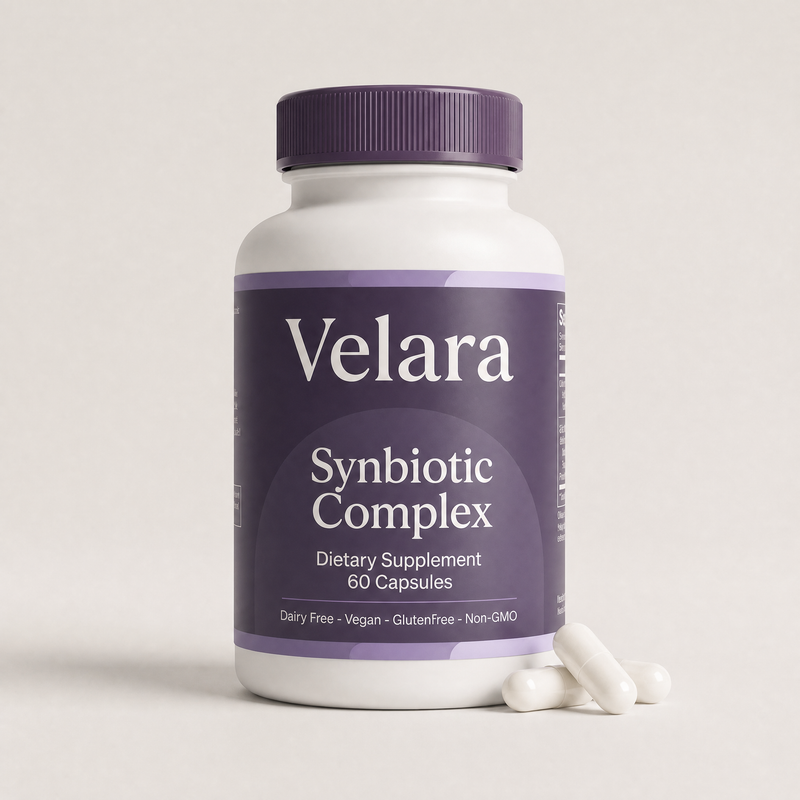
Velara pairs Lactobacillus crispatus with bovine lactoferrin in a delayed-release capsule, the same idea as the oral lactobacilli plus lactoferrin formula above. To be plain about it: those trials did not test Velara, and Velara does not treat an active infection.
| What goes wrong | What Velara uses | The goal you feel |
|---|---|---|
| Protective bacteria run low | Lactobacillus crispatus | Fewer days spent wondering if it is back |
| Short bursts do not last | Bovine lactoferrin, in a daily routine | No more restarting after every course of treatment |
| Bacteria must survive the trip | Delayed-release capsule | Nothing to insert, nothing to leak |
You take two capsules a day with breakfast and a full glass of water. It is hormone-free, needs no prescription and contains milk. Velara was formulated for women in and after menopause, so the product page speaks to them first, but the flora logic applies before menopause too.
Try Velara for 60 days, risk-free
Two capsules with breakfast, hormone-free, backed by a 60-day money-back guarantee.

What to expect
Clear the active infection first. Then judge the flora work by the calendar and not by the first week, because the trials above measured recurrence at three and six months [2][11].
Give it the full 60 days, and keep a note of episodes. The win is not a dramatic morning. It is the month you realize you have not thought about any of this.
Yeast after menopause: check what it really is
Here is something most probiotic pages skip. Yeast infections are considered uncommon after menopause, because they depend on estrogen. The exceptions are hormone therapy, uncontrolled diabetes and immunosuppression [13][10].
So if you are past menopause and "yeast" keeps returning, get it tested. Thinning, dry tissue itches too, and it will never answer to an antifungal. Our guide to vaginal dryness and itching shows how to tell them apart.
Frequently asked questions
Can probiotics cure a yeast infection?
No. An antifungal is the treatment for an active infection, and antifungals beat probiotics alone on long-term cure. Probiotics earn their place as an add-on and for what comes after.
How long do probiotics take to work for a yeast infection?
Plan on months. Add-on benefits to cure appeared within the first month of treatment, while recurrence results were measured at three and six months. They will not stop today's itch.
Can probiotics cause a yeast infection?
The Cochrane review found no increase in serious or non-serious side effects when probiotics were added to antifungals. If symptoms start or worsen on any supplement, stop it and get tested, because yeast and BV are easy to confuse.
Can I take fluconazole with probiotics?
Combining probiotics with antifungal drugs is exactly the set-up most of these trials studied. If you take other prescription medication, check with your pharmacist first.
Do oral or vaginal probiotics work better for yeast infections?
We know of no solid trial that settles this. Oral lactobacilli can shift the vaginal flora, and the recurrence trial behind our recommendation used an oral formula. Oral also means nothing to insert.
Can I insert a probiotic pill for a yeast infection?
Do not insert a capsule made for swallowing. Use only products labeled for vaginal use, and see a doctor if symptoms persist.
Our recommendation: Use the antifungal for the infection you have today, then stop leaving the flora to chance. Velara Synbiotic Complex gives you lactobacilli and lactoferrin in two capsules a day, with 60 days to judge it. Try Velara risk-free →
See a doctor if these are your first symptoms ever, if you are pregnant, have diabetes, a fever or pelvic pain, get four or more episodes a year, or have any bleeding after menopause. A home test does not replace a diagnosis, since yeast and BV can look alike.
This article is for information and is not a substitute for medical advice.
Sources
- Denning DW, et al. Global burden of recurrent vulvovaginal candidiasis: a systematic review. Lancet Infect Dis. 2018. PubMed 30078662
- Chen R, et al. Probiotics for the treatment of vulvovaginal candidiasis in nonpregnant women: a systematic review and meta-analysis of randomized controlled trials. Am J Obstet Gynecol. 2026. PubMed 41547378
- Xie HY, et al. Probiotics for vulvovaginal candidiasis in non-pregnant women. Cochrane Database Syst Rev. 2017. PubMed 29168557
- Wang S, et al. Antimicrobial compounds produced by vaginal Lactobacillus crispatus are able to strongly inhibit Candida albicans growth, hyphal formation and regulate virulence-related gene expressions. Front Microbiol. 2017. PubMed 28421058
- Jang SJ, et al. Vaginal lactobacilli inhibit growth and hyphae formation of Candida albicans. Sci Rep. 2019. PubMed 31148560
- Xu J, et al. Effect of antibiotics on vulvovaginal candidiasis: a MetroNet study. J Am Board Fam Med. 2008. PubMed 18612052
- Pirotta M, et al. Effect of lactobacillus in preventing post-antibiotic vulvovaginal candidiasis: a randomised controlled trial. BMJ. 2004. PubMed 15333452
- Sobel JD, et al. Maintenance fluconazole therapy for recurrent vulvovaginal candidiasis. N Engl J Med. 2004. PubMed 15329425
- Hilton E, et al. Ingestion of yogurt containing Lactobacillus acidophilus as prophylaxis for candidal vaginitis. Ann Intern Med. 1992. PubMed 1736766
- Sobel JD. Recurrent vulvovaginal candidiasis. Am J Obstet Gynecol. 2016. PubMed 26164695
- Russo R, et al. Randomised clinical trial in women with recurrent vulvovaginal candidiasis: efficacy of probiotics and lactoferrin as maintenance treatment. Mycoses. 2019. PubMed 30565745
- Petricevic L, et al. Randomized, double-blind, placebo-controlled study of oral lactobacilli to improve the vaginal flora of postmenopausal women. Eur J Obstet Gynecol Reprod Biol. 2008. PubMed 18701205
- Nwokolo NC, Boag FC. Chronic vaginal candidiasis: management in the postmenopausal patient. Drugs Aging. 2000. PubMed 10917071